
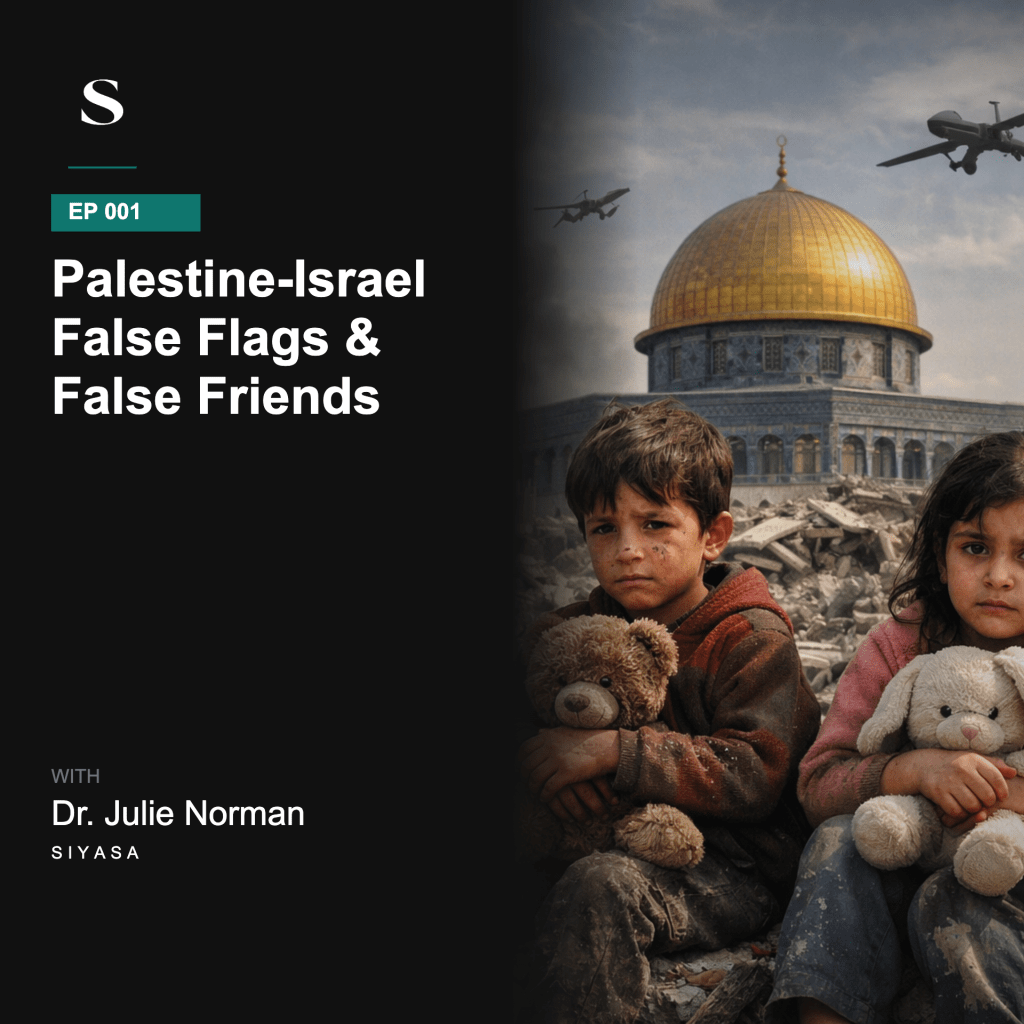
I sat down with Middle East expert Dr. Julie Norman (UCL) to discuss Palestine-Israel and dive into topics touching on international relations, questions surrounding Oct-7th, why religion is neglected in academic discourse when discussing Palestine-Israel despite its centrality on the ground, university Palestine activism, and more. Listen to the full episode on Spotify or YouTube.
Reflections
As this was my debut podcast episode with Siyasa, I was admittedly a little rusty with my interviewing. I had not interviewed anyone for just under three years. The last person I interviewed was Simon Fell MP in April 2023.
In preparation for the conversation, I skimmed Dr Norman’s book Gaza: The Dream and the Nightmare to identify areas that might be most relevant to our discussion and to better understand her framing of key events. Dr Norman teaches me at UCL and leads the Israel–Palestine module, so I already had some familiarity with her academic approach. In the classroom she tends to focus heavily on the factual side of the conflict such as key dates, wars, and developments rather than foregrounding her own personal positions.
I have always had the sense that Dr Norman is someone who is careful not to place her own personal views at the centre of discussions and instead prefers to present the historical and political record as clearly as possible. Watching the interview back, that impression largely held true during our conversation.
Having reviewed the episode myself, there were certainly moments where I could have sought further clarification or pushed back more directly on certain points. One area I wish I had explored further was the discussion around intelligence failures preceding the October 7th attacks.
For example, during the interview Dr Norman “pushes back” (timestamp 28:35) against speculation surrounding alternative explanations for the events of that day. However, even within her own book she documents instances that raise serious questions. These include reports that some IDF personnel observed Hamas training near the border months before the attack and raised concerns to their superiors, as well as the discovery of a detailed Hamas document outlining potential attack plans that was reportedly dismissed as aspirational. These details highlight significant failures in interpretation and response, and I regret not spending more time probing the implications of these points during the recording. In the next class I had with Dr Norman one of the class discussions actually related to this and what I found interesting was that while in the interview the false-flag theory was stated to be somewhat a niche conspiracy theory, my peers seemed to hold the view that Oct 7th was without a doubt a false-flag.
Another area I was particularly interested in discussing was the wave of pro Palestine student activism, especially the encampments that appeared across universities in the UK and the United States, around timestamp 35:30. I approached that part of the discussion genuinely open to hearing arguments that might challenge my own views. While Dr Norman offered thoughtful reflections, her analysis ultimately left my position largely unchanged. She acknowledged that the theory for change behind some of the encampments may have been unclear. “I think what I would ask is what is the theory for change? Like what are you trying to get out of this particular tactic in this particular space and what were your specific asks… I think that one challenge was that it wasn’t exactly clear… what was the aim for all students. Though I do think that the encampment at UCL was pretty organised…pretty clear”
Overall, however, I greatly enjoyed the conversation with Dr Norman and found her insights valuable, particularly regarding American and broader regional perspectives on the conflict. She was an excellent guest who is deeply knowledgeable and engaging, and her extensive experience travelling to and studying Palestine added meaningful context to the discussion.
Unfortunately our time was somewhat limited because Dr Norman had a Canadian television appearance scheduled shortly after our recording concluded. There were several areas I would have liked to explore further, and I intend to revisit some of the questions raised in this episode in future discussions.
The goal for Siyasa is to have every conversation begin with a political point but not ever feel rigidly like a politics only zone. In fact, that is the one reason I created Siyasa. But with the Middle East being extremely intense at the moment (with Iran, Israel, the US, and a number of Arab Gulf states) it will be hard to not have a few more guests in succession of one another who will be of a similar background as Dr Norman. But I definitely intend to try book guests with a STEM / artistic background soon, Insha’Allah.
Alhamdulilah, Thumma Alhamdulilah.
Allahumma Salli wa Salim ‘Ala Habibina wa Nabina Muhammad ﷺ.
 Siyasa: Clarity Is Power
Leave a comment